The Assistant That Actually Knows Your Production

Victoria Holden
August 27, 2026 · 4 min read
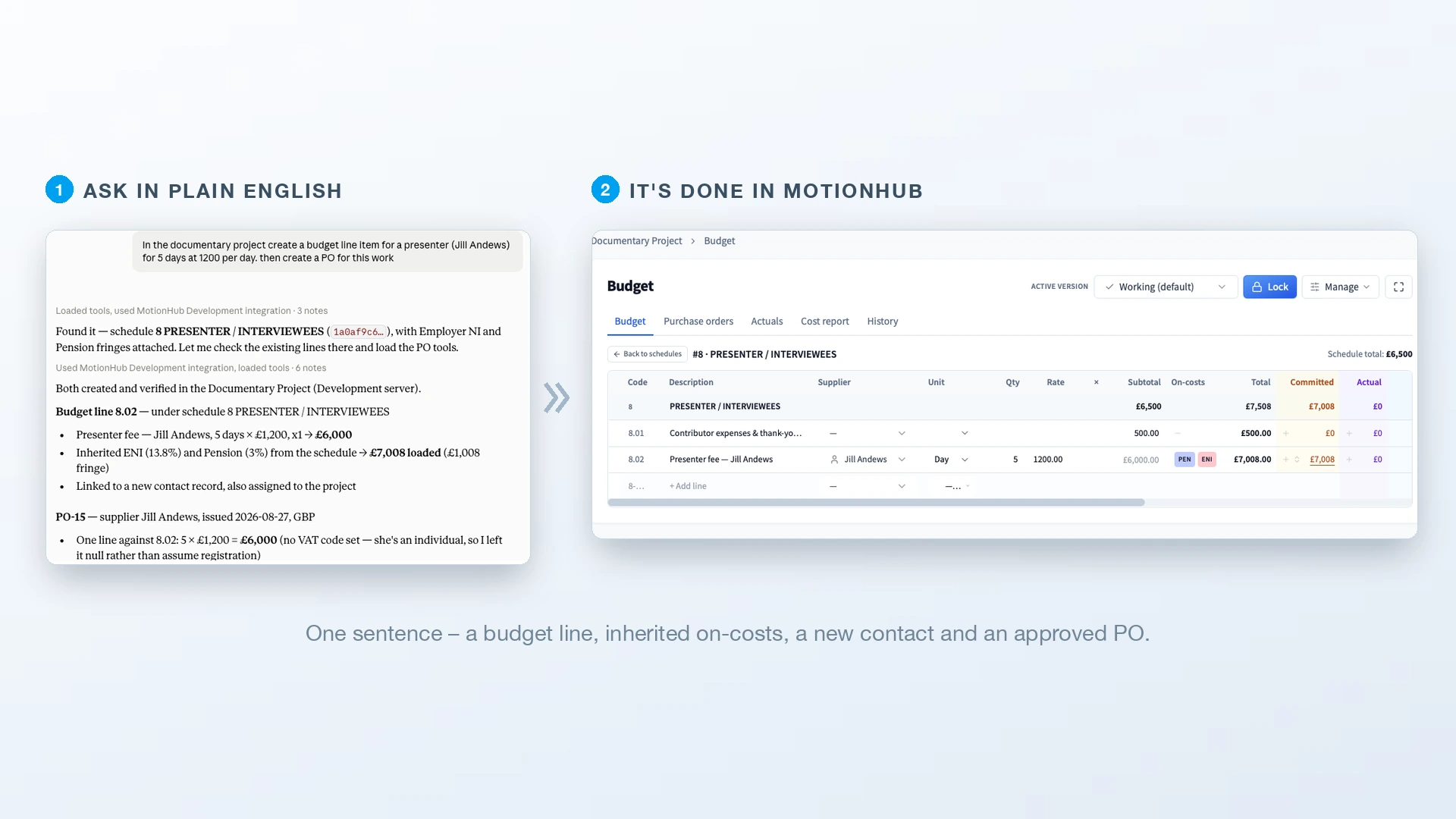
Every producer I know has now had the same slightly deflating experience with AI.
You open Claude or ChatGPT, you ask it something genuinely useful – “who’s available for the Bristol shoot next Thursday?” – and it writes you a beautifully formatted, entirely fictional answer. Or, if it’s being honest, it explains that it has no way of knowing.
Of course it doesn’t. It’s never seen your calendar.
The context problem
The AI conversation in television has been stuck on capability for two years. Can it write? Can it summarise? Can it transcribe? Yes, obviously, and it’s getting better at all of it.
But capability was never the bottleneck for production teams. The bottleneck is that the tools with all the intelligence have none of the information, and the tools with all the information have none of the intelligence.
Your production data lives in a scheduling tool, a budget spreadsheet, a media library, a folder of scripts, and about four hundred WhatsApp messages. The AI that could actually reason about it has access to none of that. So it does the only thing it can: it generalises. It gives you a template when you needed an answer.
That gap is where most of the disappointment with AI in production has come from. Not that the models are bad – that they’re working blind.
What changes when it can see
Something quietly significant has shifted in the last year. AI assistants can now connect directly to the systems where work actually happens, with proper authentication and proper permissions. Not scraping, not copy-paste, not an integration that syncs a stale copy overnight. A live connection, scoped to what you’re allowed to see.
The change in what you can ask is not incremental.
“How much have we spent on catering across the whole shoot?” stops being a spreadsheet exercise and becomes a sentence. “Find the clips where the contributors talk about funding” stops being an afternoon of scrubbing through rushes. “Is Sarah free on the 14th?” gets an answer that’s actually true, because something looked.
The tasks themselves aren’t new. Producers have always needed to know these things. What’s new is the distance between having the question and having the answer – and in a production office, that distance is most of the job.
Where the time actually goes
There’s a particular kind of work that eats production schedules and appears on no budget line. Cross-referencing. Checking. Chasing the thing you know you wrote down somewhere.
Nobody plans for it. Nobody bills for it. But a producer mid-shoot can lose an hour a day to it – the hour that goes on opening the calendar, filtering by date, cross-referencing against the crew list, then opening the budget to check whether the overtime is affordable, and finally making a decision that took thirty seconds of actual thought.
The thinking was never the slow part. The retrieval was.
Collapsing retrieval to a sentence doesn’t replace anyone’s judgement. It just stops burning judgement time on lookup.
Guardrails matter more than capability
Here’s the part that gets less attention than it should: an assistant with real access to real production data needs real limits.
It should work inside your permissions, not around them – if you’re a Reader on a project, so is your assistant. It should refuse to delete the things that shouldn’t be casually deletable: budgets, media, contributor records. It should ask before it does anything destructive. And every action it takes should be visible afterwards, in the same audit trail as everything a human did.
None of that is glamorous, and none of it demos well. But it’s the difference between a tool a production company can actually adopt and one that legal quietly kills.
An assistant that can do anything is not what anyone wants supervising a shoot. An assistant that can do exactly what you can do, and shows its working, is.
The useful version of AI in production
The interesting question was never “will AI replace producers”. It’s much smaller and much more practical: how much of the working day is spent looking things up, and what happens if that stops?
We’ve connected MotionHub to Claude and ChatGPT to find out. Your projects, schedules, media, scripts and budgets – reachable in plain English, inside your permissions, with everything logged.